The city of León is known for being one of the most popular starting points for pilgrims embarking on their adventure along the French route of the Camino de Santiago. It is 306 km from Santiago de Compostela, usually divided into 13 stages.
You might also like: Camino de Santiago from Ponferrada
The entire route to Santiago is not overly difficult, with an average daily distance of 24-25 km, feasible for most pilgrims. Looking at its elevation profile, the most challenging part is the ascent to O Cebreiro, iconic place in the French Way. This climb can be a little tough, especially in wintertime, when the snow can prevent pilgrims from walking. This is how, centuries ago, another of the main routes emerged, Winter Way, so-called because it turned towards the south of Galicia, avoiding the snowy climb.
Nowadays, even in winter, this ascent is manageable thanks to modern gear and much better physical preparation by today’s pilgrims.
-
Index
- Why from León?
- Walking stages
- Cycling stages
- How to get there
- Where to sleep
- Where to get pilgrim credential
- Places of interest
Why from León?
Over the years, León has become one of the most important towns in the French Way, and so it offers everything a pilgrim may need.
This, in addition to the beauty of its historic centre and its cathedral, makes that many pilgrims arrive a day earlier to enjoy the area before setting off on their adventure in the Camino de Santiago.
Walking stages
| STAGE | START | END | DISTANCE | DIFFICULTY |
|---|---|---|---|---|
| Stage 1 | León | San Martín del Camino | 24.6 km | ★★☆☆☆ |
| Stage 2 | San Martín del Camino | Astorga | 23.7 km | ★★☆☆☆ |
| Stage 3 | Astorga | Foncebadón | 25.8 km | ★★☆☆☆ |
| Stage 4 | Foncebadón | Ponferrada | 26.8 km | ★★★☆☆ |
| Stage 5 | Ponferrada | Villafranca | 24.2 km | ★★☆☆☆ |
| Stage 6 | Villafranca | O Cebreiro | 27.8 km | ★★★☆☆ |
| Stage 7 | O Cebreiro | Triacastela | 20.8 km | ★☆☆☆☆ |
| Stage 8 | Triacastela | Sarria | 17.8 km | ★☆☆☆☆ |
| Stage 9 | Sarria | Portomarín | 22.2 km | ★☆☆☆☆ |
| Stage 10 | Portomarín | Palas de Rei | 24.8 km | ★☆☆☆☆ |
| Stage 11 | Palas de Rei | Arzúa | 28.5 km | ★★★☆☆ |
| Stage 12 | Arzúa | O Pedrouzo | 19.3 km | ★☆☆☆☆ |
| Stage 13 | O Pedrouzo | Santiago de Compostela | 19.4 km | ★☆☆☆☆ |
Bicycle stages
| STAGE | START | END | DISTANCE | DIFFICULTY |
|---|---|---|---|---|
| Stage 1 | León | Astorga | 49 km | ★★☆☆☆ |
| Stage 2 | Astorga | Ponferrada | 53 km | ★★★☆☆ |
| Stage 3 | Ponferrada | O Cebreiro | 55 km | ★★★☆☆ |
| Stage 4 | O Cebreiro | Portomarín | 62 km | ★★★☆☆ |
| Stage 5 | Portomarín | Arzúa | 54 km | ★★☆☆☆ |
| Stage 6 | Arzúa | Santiago de Compostela | 39 km | ★★☆☆☆ |
How to get to León
In our section about how to get to the main starting points of the Camino de Santiago, we have all the necessary information to assist pilgrims finding their way to some of the main towns in the Camino.
To reach León, these are the main access routes:
- By road: León has good connections to different parts of the peninsula thanks to the Spanish motorway and dual carriageway network, whether you are travelling in your own vehicle or by bus.
- By train: whether directly or with a change, you can reach León by train from almost anywhere in Spain.
- By plane: even though León has its own airport, it only connects to certain points of Spain, some of which may not even operate throughout the year.
If you travel from abroad and reach Spain by plane, we recommend you to fly into Madrid, as you will have several departures by train per day that will drop you off at León’s city centre. You can book your tickets in Renfe’s official website.
Where to sleep in León
Given its significance in the Camino, León offers a wide range of accommodation, from pilgrim hostels to hotels and Paradores.
Here are two recommended hostels for your night in León before starting to Santiago:
- Benedictine Monastery Hostel
- Capacity: 132 beds
- Address: Plaza Santa María del Camino, León
- Phone: 987 252 866 / 680 649 289
- San Francisco de Asís Hostel
- Capacity: 100 beds
- Address: Plaza Santa María del Camino, León
- Phone: 987 252 866 / 680 649 289
During certain times of the year, accommodation may get booked up quickly, so in order to guarantee your stay in León, and the next ones along the Camino, you can contact us and we will make all the arrangements for you. We can also organise a transfer to your accommodation from any airport or station you arrive at.
Where to get your pilgrim credential
You may contact the Amigos del Camino de Santiago de León association. However, at Pilgrim we give it to you if you book your experience with us.
Places of interest
As already mentioned, León has an exquisite old town, where you can relish history, architecture, gastronomy and much more.
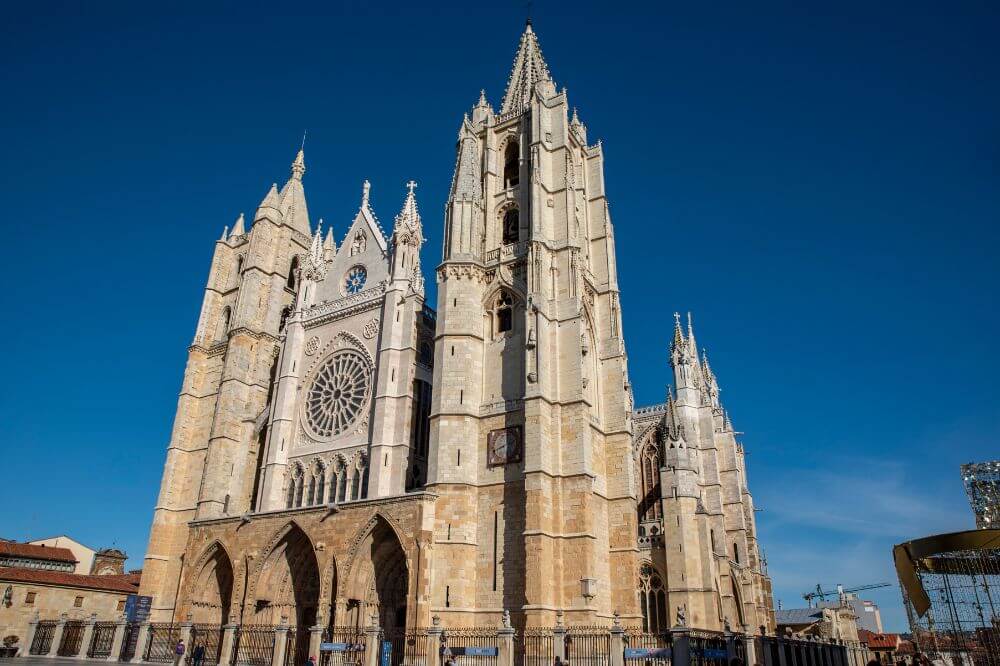
León Cathedral
León Cathedral dates back to the 10th century and stands on the site of the ancient thermal baths and public buildings erected by Legio VII at the end of the 2nd century. After defeating the Arabs at the Battle of San Esteban de Gormaz, the king donated this building with the aim of constructing the first cathedral on the site. It was by order of Princess Urraca, sister of Fernando I, that construction began on a new building made entirely of brick and masonry.
This cathedral remained completely intact until the end of the 12th century, when Alfonso IX came to the throne and ordered the construction of the current building. This new building consisted of three naves between the entrance and the transept, extending to five naves between the transept and the high altar. These naves were all covered with ribbed vaults. The interior was topped off with a large apse.
Plaza Mayor
The Plaza Mayor is the main square in the town, both for being the leisure hub and administrative centre. Its construction took place over two periods: first, from 1654 to 1672, projected by Antonio Ambrosio, and a second one from 1677, when Francisco del Piñal decided to remodel it after a fire.
Nowadays, the arcades and half-storey houses remain and continue to house the market, while leisure establishments proliferate under the columns.
Convent of San Marcos
The Convent of San Marcos was built thanks to a donation made by Princess Lady Sancha in the 12th century, aimed at creating a hospital outside the city to host pilgrims on their way to Santiago.
Noteworthy features of this building include its Plateresque style façade with austere features. The building is divided into three sections, the third being a decorative openwork floral motif. The most interesting features of the complex are the two niches located in each of the church’s towers.
Adventure awaits
We hope that all this information on doing the Camino from León will motivate and give you the necessary support to embark on this adventure and enjoy the magic of the Camino de Santiago.
Should you need help planning your experience, we will be at your disposal. Simply leave your contact details and we will find the best way to assist you.
¡Ultreia, pilgrim!